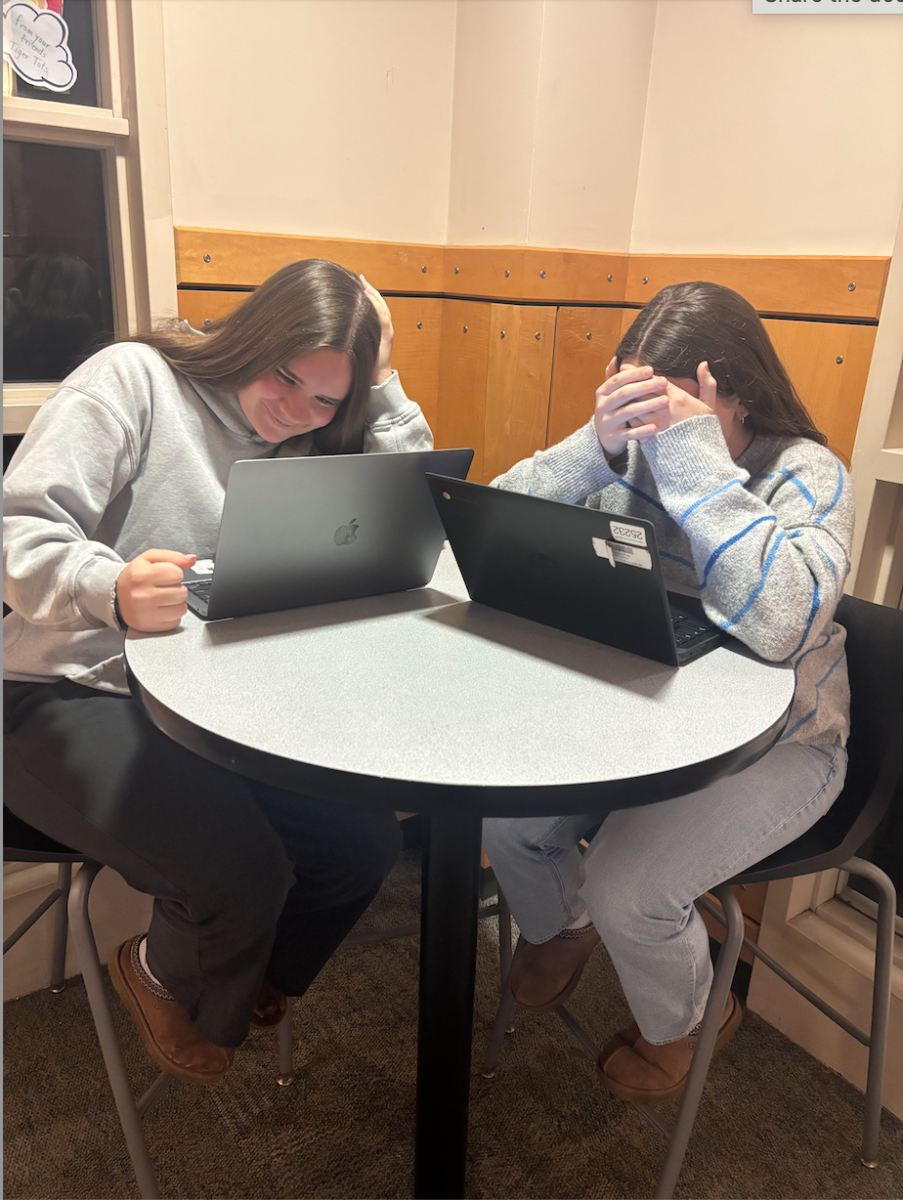

We have all been there at some point during our high school careers; whether it was coming home from a game or coming back from an orchestra concert, we are exhausted.
It’s already 10 p.m., and all you want to do is eat and go to bed. You know you have to be up for school by seven the next morning, but you can’t; you have at least three hours of homework to go. That is, if you don’t have any tests coming up. This is one of the reasons why many students don’t go to bed until the early morning hours. Overtime This habit of late-night homework becomes increasingly more common.
The habit of studying all night shouldn’t be a habit in the first place. In the beginning, homework was used as a tool for students who hadn’t finished classwork or who needed extra help; however, for many students,it has transitioned to a source of burnout and unnecessary stress.
The real questions that we should be asking our teachers and students are: when does the amount of homework being given to students become ineffective? When do we stop caring?
Well, while many would argue that nightly practice is vital for success, research has shown that there are limitations. Students commonly lose interest or can’t focus after two hours of work; fatigue sets in. This is a detriment to our students’ overall health. But what can we do about this? Massachusetts does have suggestions for how students should control homework load, suggesting the National PTA’s “10-minute rule“ (10 mins/grade level); some schools set specific limits, such as Quincy (20 mins/subject in middle school, 30 mins in high school) or Somerville (60 mins total for grades 6-8). Common guidelines suggest minimal or optional homework in K-2, increasing to 30-60 mins in elementary, 60-90 mins in middle school, and potentially 2+ hours in high school, with a focus on quality, purpose, and avoiding overload across subjects. This is a guideline that many schools follow.
Now you may be wondering if Ipswich High School follows any guidelines regarding homework. Our student handbook states that we should “expect rigorous homework.” Based on my experience, I would say that it depends on the class and the teacher.
When speaking to some of the students at Ipswich High School on the subject of homework, there was a range of answers. On average freshman were spending about two hours on homework a night, while seniors were spending an average of 3 hours a night. Many students didn’t think homework was useful. When interviewing Tilly Adams, an IHS freshman, she said, “There is so much, and I am in a rush to do it. If I take my time to learn the information, it wouldn’t be done until at least midnight.” I also asked if she feels homework helped or hindered her learning. She said, “It depends. Sometimes it helps because I can relook over what I learned in class. Other times it’s harder and more confusing.” She is just one of many who have this opinion. It’s not an option to get rid of homework completely, but to make it manageable. I believe that 45 minutes a day for homework is optimal.
But to fully understand the purpose of homework, we also need to see a teacher’s perspective. Therefore, I asked Barbra Mahick, a second-grade teacher, what she believes is the primary goal of assigning homework. She said, “It is to reinforce what we are teaching and see what kids can do independently. But homework should be what they already learned and understand. It also establishes good routines and work habits like reading for 20 minutes.” Homework should be for review and check-in.